

Flake Epoxy Garage Floors
The speckled garage finish that hides small slab flaws, with a July work-day schedule and a price table that runs from one bay to five.
Typically from $5/sq ft
Garage floors and business floors · Epoxy and polyaspartic coatings
Epoxy Floors Lane Menifee is a local guide and availability check for epoxy and polyaspartic floors in Menifee — flake, solid-color and metallic coatings in garages from Sun City to the newest tracts south of Newport Road, and floors for shops, kitchens, showrooms, gyms and clinics near Interstate 215. See a typical price for your own square footage, how the systems compare, what a hot Inland Empire summer means for a work day, and whether a local coating installer has openings for your ZIP yet.
Notify me when bookings open · typical prices in about 30 seconds
Bookings aren't open yet. Leave your name and number; your message is recorded, and you'll get one message when a local installer is available.
 Illustration
AI-generated illustration. The people shown are not real installers.
Four systems, one prep method: every garage floor starts with a ground, repaired and moisture-checked slab.
The speckled garage finish that hides small slab flaws, with a July work-day schedule and a price table that runs from one bay to five.
Typically from $5/sq ft

A fast-curing, more UV-stable top coat over an epoxy base, with what heat and a new slab do to it laid out before the price.
Typically from $6/sq ft

The lowest-cost professional coating, one clean color with grit where grip matters, compared with a kit in a hot garage.
Typically from $3/sq ft

The decorative garage floor of base color, metallic pigment and clear top coat, with the cost, care and heat notes up front.
Typically from $8/sq ft

Grinding, repair and moisture testing for a new tract slab or an older one, the part of the job that decides whether a coating stays down.
Typically from $1/sq ft

A symptom-to-cause table for failed garage floors in an Inland Empire climate, then the removal methods and the price.
Typically from $1/sq ft
 Illustration
Typical total $4,400–$7,600
 Illustration
Typical total $3,050–$5,900
 Illustration
Typical total $3,750–$6,050
 Illustration
Typical total $20,700–$52,100
 Illustration
Typical total $10,500–$18,700
 Illustration
Typical total $13,600–$34,200
Hypothetical typical projects. Pictures are AI-generated concept illustrations, not photos of completed installations; no installation was performed or arranged through this site; prices are typical Menifee area market ranges, not quotes.
Garage or business, size, system and slab, one question at a time; the total updates as you go.
Takes about 30 seconds · no sign-up to see your range
Check availability and get your Menifee area price range
Bookings aren't open yet — a typical Menifee range in about 30 seconds.
Menifee's problem is rarely damp air. It is heat, and slabs so new that the question is whether they are ready. Summer afternoons are hot enough to shorten the working time of a fast-curing product, and a large share of the garages here belong to tracts built in the last two decades, many inside a homeowners association that has its own view of a garage door standing open.
| Months | Typical weather | What it means for a coating |
|---|---|---|
| June–September | The hottest stretch: mean highs of 97°F in July and 98°F in August, with a record of 117°F | Installers favor early starts; fast-cure products have less working time on a hot afternoon, and a slab that is warm by midday affects outgassing and bubbling |
| October–November | Highs ease off and nights cool | A workable window for many jobs; the slab swings from cool at dawn to warm by afternoon, so installers still check its temperature and the dew point |
| December–March | Cool nights, with a January mean low of 39°F | A cold slab cures slowly, so return times move toward the longer end of the data sheet; installers watch the overnight low |
A tract-home slab can be a few months old when the first owner thinks about a floor. Coating manufacturers advise waiting at least 28 days after the pour, and in some conditions as long as 60. Age alone does not decide it: a slab can be cured and still be too wet for a coating, which is why a moisture test, ideally in-slab humidity probes, matters more than the calendar. The system being installed sets the moisture level it will tolerate.
Associations in Menifee's newer neighborhoods set their own rules in their CC&Rs. The inside of a garage is usually not covered, while contractor parking, working hours and how long a garage door stays open sometimes are. A short note to the management company that names the address, the dates, the fact that the work is inside the garage, where the crew parks and why the door stays open for ventilation saves a stop-work call. The association, not this site, decides what applies.
General guidance from public climate records and coating-maker advice, not measured data for a specific slab; the product data sheet and the association decide what applies.
A warehouse aisle, a restaurant kitchen and a showroom want different systems. Each kind has its own page with a zone-to-system table, a downtime plan and the questions to ask a contractor.
IllustrationAisle, dock and joint planning for warehouse and light-industrial floors, with a heat-at-the-door section and a sample budget.
Often considered Solid-color epoxy with grit
Typically from $3 per sq ft
IllustrationUrethane cement and epoxy options for kitchens and food areas, with coved bases and the county plan check explained.
Often considered Urethane cement (heat and washdown areas)
Typically from $10 per sq ft
IllustrationBay-by-bay system choices for repair shops, with lift-pad cautions, fluid exposure, grit trade-offs and a sample budget.
Often considered Solid-color epoxy with grit
Typically from $3 per sq ft
 Illustration
Decorative flake and quartz floors for strip-center stores and showrooms, with glare, scuff and phasing advice.
Often considered Decorative flake (chip) epoxy
Typically from $6 per sq ft
 Illustration
Coating and rubber zones for gyms and studios, with wet-area notes and a plan for staying open between classes.
Often considered Decorative flake (chip) epoxy
Typically from $6 per sq ft
 Illustration
Seamless, easy-to-clean floors for private medical, dental and veterinary suites, installed room by room.
Often considered Solid-color epoxy with grit
Typically from $3 per sq ft
Price a business floor Each kind of floor has its own page under Commercial floors in the menu.
Every garage system is a stack: a ground slab, a primer, a base coat, color flake or pigment and a top coat. The stack decides how it looks and how it wears; each diagram shows the layers in order.
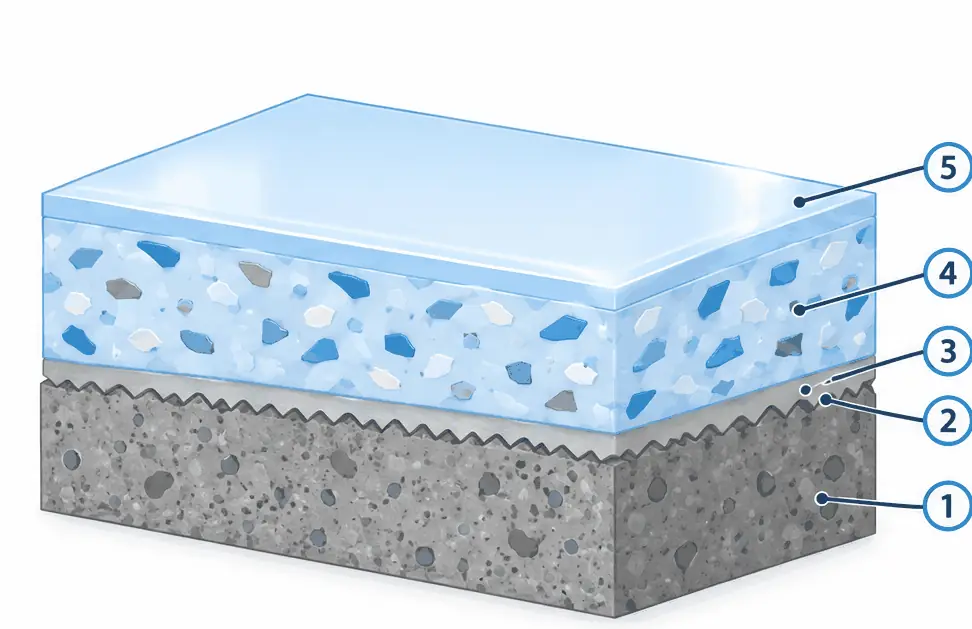
Fits Fits a typical two-car tract garage where hiding small slab flaws and getting some texture matter more than a showroom shine.
Typically $5–$8 per sq ft about $2,000–$3,200 for 400 sq ft, installed
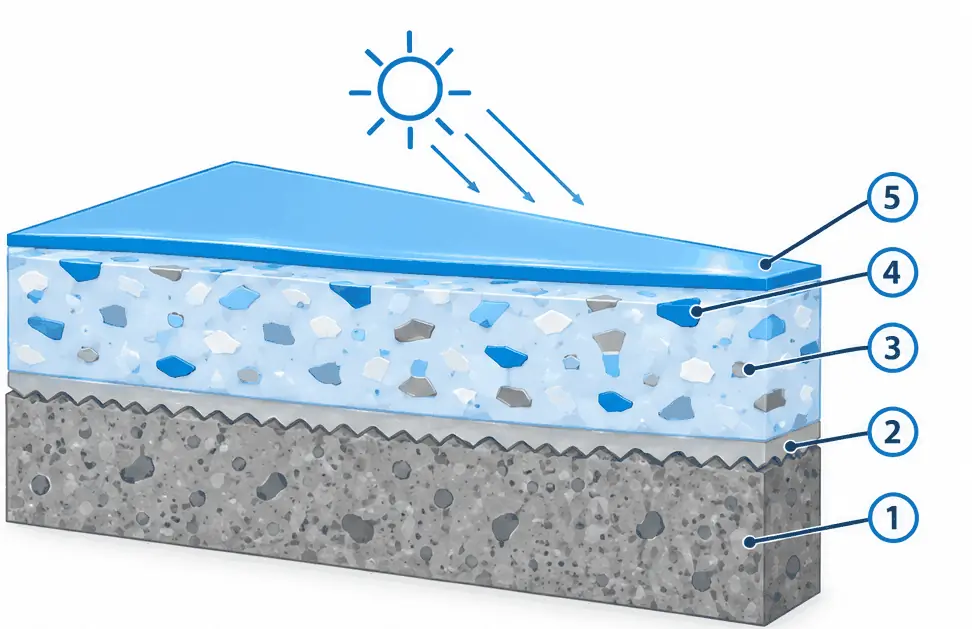
Fits Fits a garage whose door faces the afternoon sun, where a more UV-stable top coat and a short return-to-service time are worth the extra per square foot.
Typically $6–$10 per sq ft about $2,400–$4,000 for 400 sq ft, installed
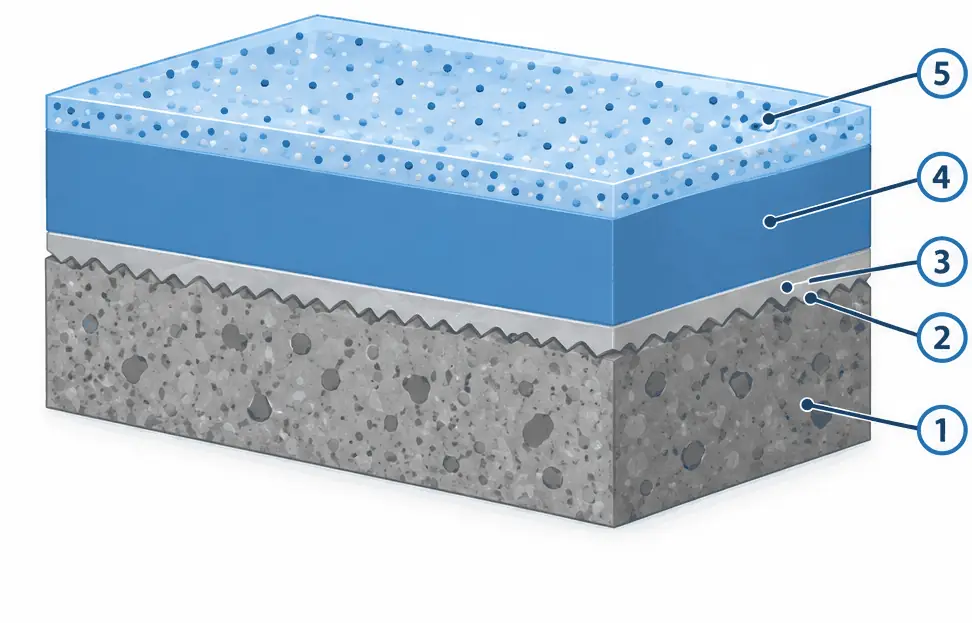
Fits Fits a workshop, a storage garage or any budget job where a clean single color is enough, with grit added where grip matters.
Typically $3–$6 per sq ft about $1,200–$2,400 for 400 sq ft, installed
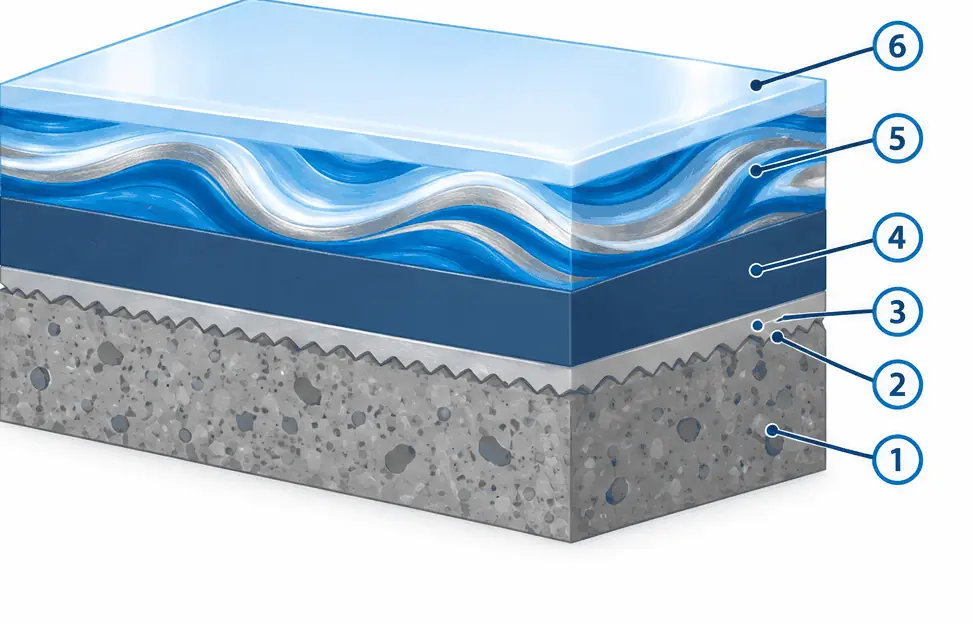
Fits Fits a garage used as a show-car room or a gym, where the swirl pattern is the point and the owner accepts more care in cleaning.
Typically $8–$12 per sq ft about $3,200–$4,800 for 400 sq ft, installed
A quote that lists these lines can be compared with the next one. A quote that does not is hard to compare.
Warranty terms are set by the installer and by the coating manufacturer; ask what is covered (peeling, hot-tire pickup, UV yellowing), for how long, and whether the prep is part of it.
 Clear and lookThe garage is emptied and the slab is measured and looked over for cracks, oil, old paint, damp spots and the joints that were cut when it was poured.
 Grind the slabA diamond grinder with a dust shroud and a vacuum scuffs the surface to an even, open profile that a coating can grip; an acid etch alone grips less.
 Fill and checkCracks and chips are filled and ground flush, then the slab is tested for moisture, since a new slab can look dry long before it is.
 Roll the base coatPrimer and a pigmented base coat go on while the slab is at a workable temperature, and in Menifee that often means a morning start.
 Broadcast and sealColor flakes are thrown into the wet base by hand, the loose ones are scraped off, and a clear top coat locks the rest in and sets the sheen.
 Cure before useShoes come first, tires later, each after the time on the product data sheet for that day's temperature and humidity.
Each product argues for itself, so here are the trade-offs side by side. Polyaspartic is one kind of polyurea; many garage systems use an epoxy base with a polyaspartic top coat. Ranges are the typical Menifee prices from the estimator on this page.
| System | UV and yellowing | Install speed | Odor and cure | Estimator range, per sq ft | Typical weak spot |
|---|---|---|---|---|---|
| Epoxy base and epoxy top coat | Can amber in sunlight, noticeable with the door open | Longer working time; often several days before a car | Strong odor while curing; slower cure | $3–$8 solid or flake | Hot-tire pickup and yellowing on thin, poorly prepped floors |
| Epoxy base and polyaspartic top coat (hybrid) | Top coat is generally more UV-stable | Often a day or two, depending on the product | Odor while curing; return time set by the data sheet | $6–$10 polyaspartic flake | The bond to the slab, so it depends on the grind |
| Polyaspartic or polyurea throughout | Generally UV-stable | Many systems install in one day | Strong odor in the first days; very short working time in heat | $6–$12 depending on system | Short pot life; sensitive to a damp slab |
| Metallic epoxy with a clear top coat | Depends on the clear coat chosen | Skilled application, several days | Same cure rules as epoxy | $8–$12 | Shows scratches; the swirl pattern cannot be repeated |
Values are general product behavior, not a promise; the data sheet of the named product and the day's temperature and humidity decide. Market estimates, not a quote.
Pick a base color and two to four flake colors. The swatches show the same mix as a full broadcast, where the flakes hide the base completely, and as a partial broadcast, where the base shows between them.
On-screen approximation; ask for a physical sample board.
Epoxy Floors Lane Menifee covers Sun City, Quail Valley, Romoland, Menifee Lakes, Audie Murphy Ranch, Menifee Town Center, Newport Road corridor, Southern Gateway — pick your neighborhood from the menu for local details and ZIP codes.
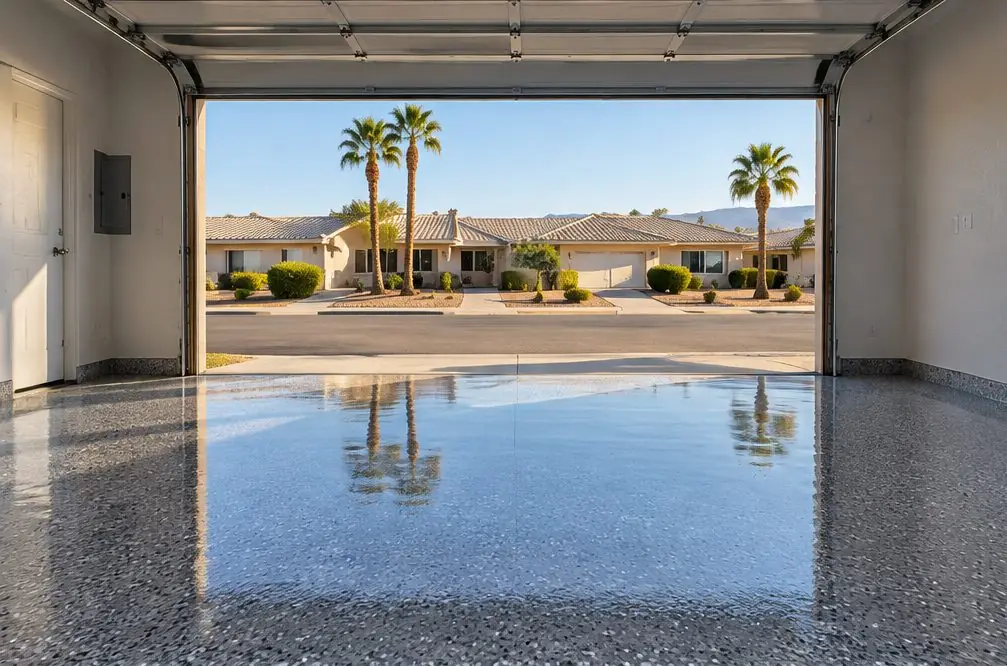
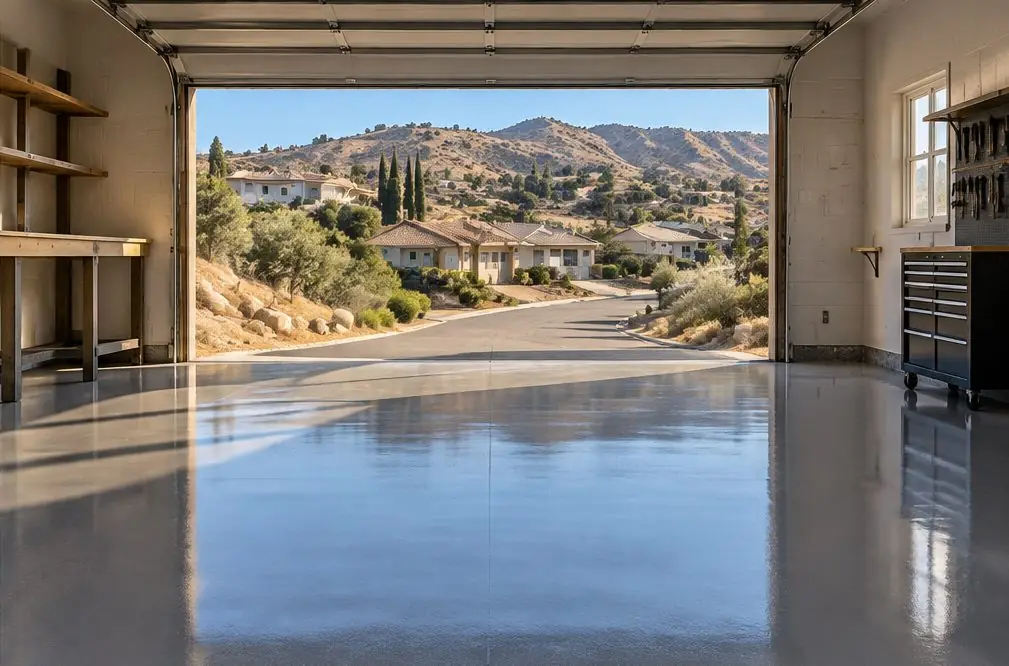
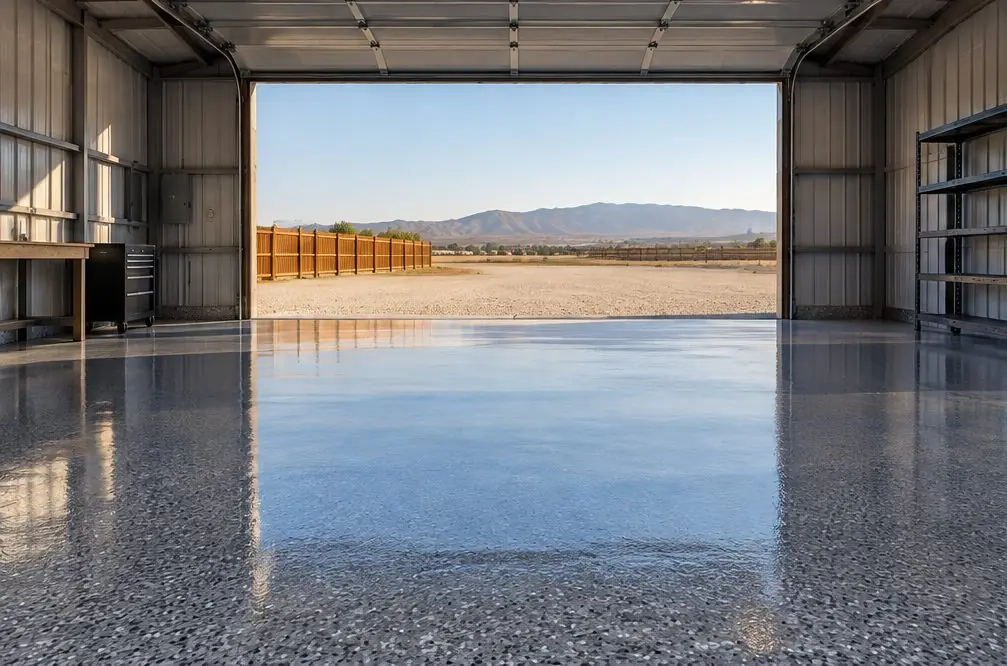
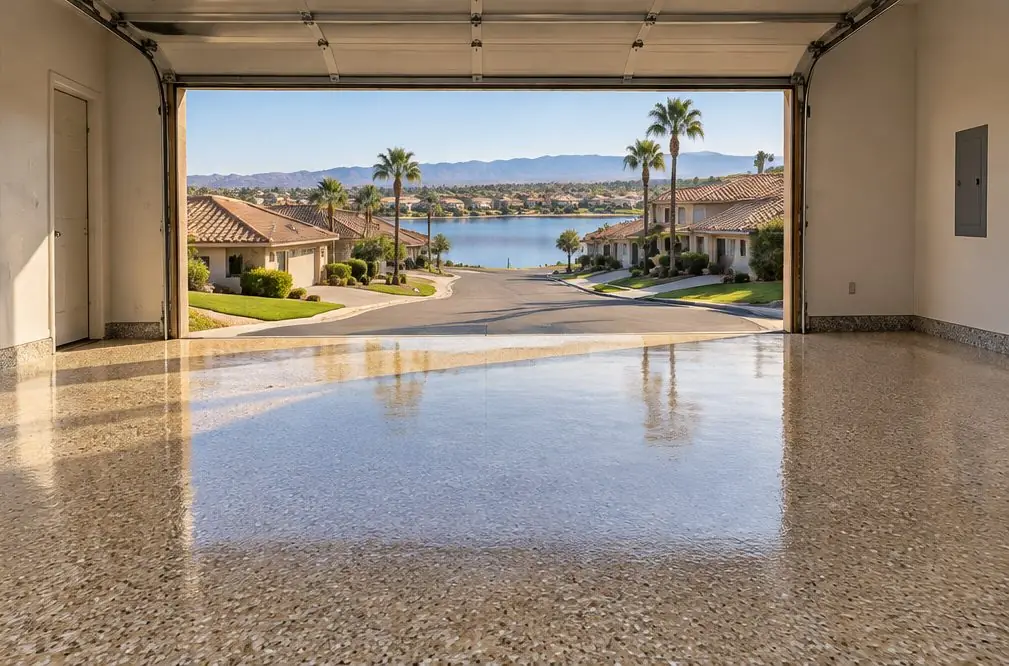
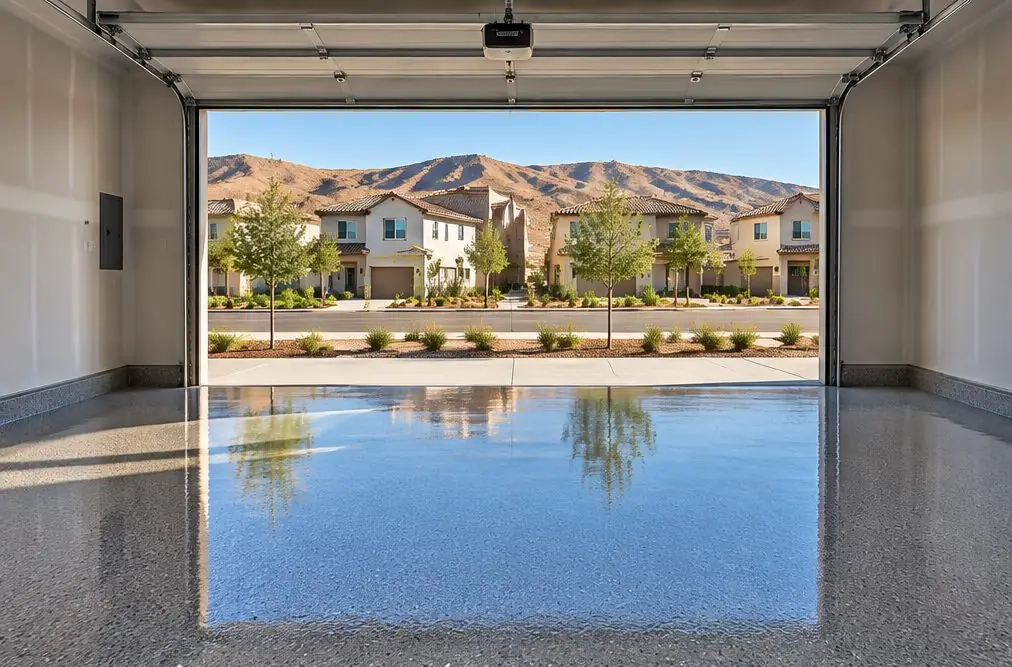
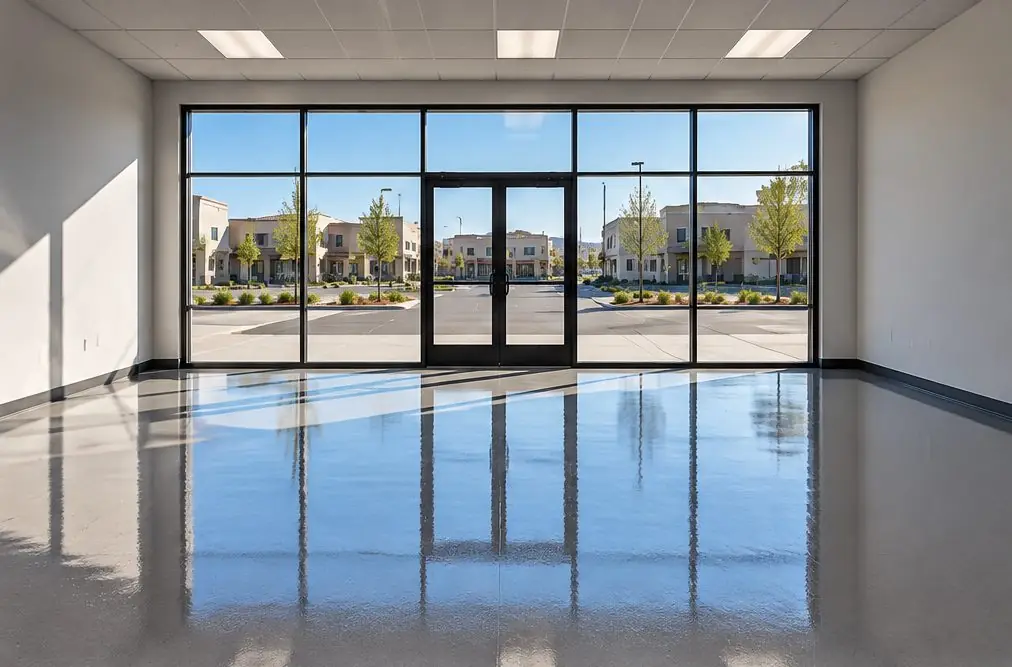
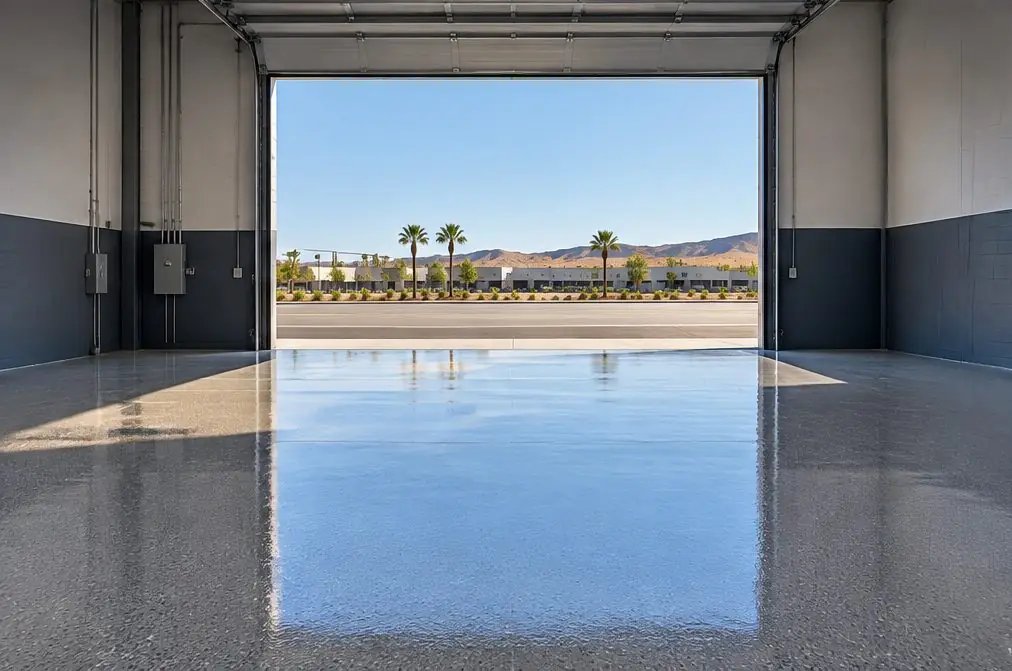
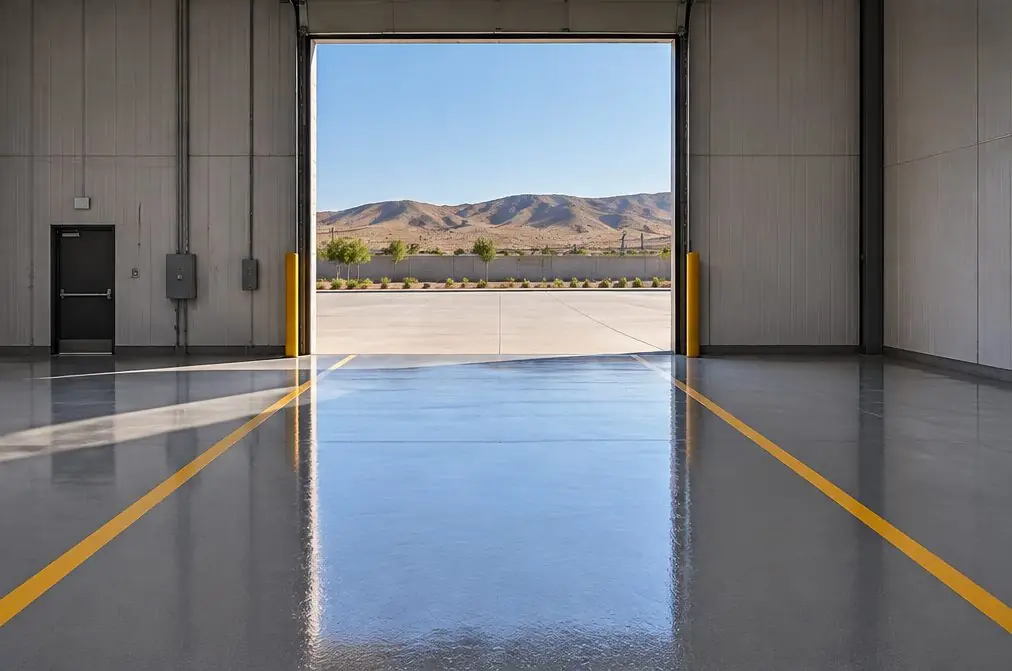
Market ranges for 2026 run about $5–$8 per square foot for full-broadcast flake epoxy, $6–$10 for polyaspartic flake, $3–$6 for solid color and $8–$12 for metallic, installed on a sound slab. A two-car garage of about 400 square feet therefore lands around $2,000–$3,200 for flake. A price guide for Menifee lists $6–$9 per square foot for epoxy in general. Cracks, an old coating to remove or a damp slab add $1–$4 per square foot. These are market estimates, not quotes.
Typical commercial ranges are $3–$7 for solid-color epoxy with grit, $6–$12 for decorative flake, $8–$15 for quartz broadcast and $10–$18 for urethane cement used in kitchens and washdown areas. Small jobs, coved bases and slab repairs move the price; the business path of the estimator adds each line.
Neither wins everywhere. Epoxy works well as a base coat because it bonds to a ground slab and has a longer working time; polyaspartic top coats are generally more UV-stable and cure faster. Many garages use an epoxy base with a polyaspartic top coat. The table above lists the trade-offs.
Manufacturers commonly advise at least 28 days after the pour, and up to 60 in some conditions. Age is not the test: a slab can be cured and still hold too much moisture, so a moisture test decides, and the data sheet of the chosen system names the limit.
Yes. A hot slab and hot air shorten the working time of fast-curing products and can cause bubbles or pinholes as the slab warms. Installers tend to start early and check the slab temperature; the time of day is a fair question for a quote.
Usually the slab was not opened up enough, was damp, or was oily when coated. Acid etching alone is a weaker bond than diamond grinding. The removal and prep pages list the other causes.
It depends on the system, the temperature and the humidity. Many polyaspartic systems can be installed in one day, and foot traffic usually resumes the next day. Vehicles return after the time on the product's data sheet, often 24 hours to several days; epoxy systems usually take longer.
It is worth checking the community's CC&Rs before the work starts. Some rules cover contractor parking, work hours and how long a garage door may stay open; the association, not this site, decides what applies.
A coated floor can be slippery when wet or oily. Broadcast flake and a fine grit added to the top coat add texture and grip; a heavier grit adds more grip and is harder to clean, so the amount is a choice between the two.
Hot-tire pickup — a warm tire lifting the coating — is mostly a prep and product problem. A ground slab and a system rated for it reduce the risk.
In California, floors in food facilities must be smooth, durable, nonabsorbent and easily cleanable, with a coved base where floor meets wall. The Riverside County Department of Environmental Health reviews plans for new or remodeled food facilities and inspects them. The kitchen page lists the questions to ask.
Often, in phases. Commercial installs are usually scheduled after hours, on weekends or one zone at a time. The downtime guide and the business path of the estimator include a schedule flag for the contractor.
Kits cost less but typically give a thinner film and need a rented grinder and careful moisture handling. The solid-color page compares a kit with a professional job line by line.
No. Installers featured here are independent businesses. The installer's legal name and business details are published on this site before bookings open.
Garages and businesses across Menifee — Sun City, Quail Valley, Romoland, Menifee Lakes, Audie Murphy Ranch and the retail and business districts near Interstate 215 among them. The availability check shows whether bookings are open for a ZIP.
Typical Menifee area floor coating prices, square foot by square foot
Pick garage or business, the size and the system, and see the range. No contact details needed. Bookings open here once a local installer is named on this site.
Bookings aren't open yet. Leave your name and number; your message is recorded, and you'll get one message when a local installer is available.